Pa Kua Chang (Baguazhang, 八卦掌) is a circular Chinese martial art taught at Imperial Combat Arts schools. Rooted in Taoist philosophy and structured around the Eight Trigrams (Bagua) of the I Ching, Pakua is known for its evasive footwork, angular entry, and continuous motion.
Historically associated with Dong Haichuan (19th century), Pakua developed as a maneuver-based combat system emphasizing position, angle, and adaptive response rather than direct linear exchange.
At Imperial Combat Arts, Pakua is taught as one of the core pillars of Imperial Wu Tang. It is trained as a functional movement and tactical system — not solely as health exercise or performance art.
Historically associated with Dong Haichuan (19th century), Pakua developed as a maneuver-based combat system emphasizing position, angle, and adaptive response rather than direct linear exchange.
At Imperial Combat Arts, Pakua is taught as one of the core pillars of Imperial Wu Tang. It is trained as a functional movement and tactical system — not solely as health exercise or performance art.
DESIGN INTENT
Pakua was designed to develop:
Where Hsing I drives forward through the line, Pakua moves around it.
Rather than meeting force head-on, Pakua seeks to:
Its power is generated through torque, rotation, and coordinated stepping rather than linear penetration.
- Angular entry and flank positioning
- Continuous directional change
- Evasion combined with immediate counter
- Joint control within motion
- Structural redirection rather than collision
Where Hsing I drives forward through the line, Pakua moves around it.
Rather than meeting force head-on, Pakua seeks to:
- Reposition
- Overlap opponents
- Attack from blind angles
- Disrupt structure while in motion
Its power is generated through torque, rotation, and coordinated stepping rather than linear penetration.
CORE TRAINING PROGRESSION
Training progresses through:
Students begin with structure and stepping precision before advancing to continuous maneuvering.
Circle walking is not aesthetic ritual. It develops:
Only after posture and stepping are stable do students begin high-speed application.
- Foundational palm changes
- Stationary body mechanics
- Circle walking (Zou Zhuan)
- Eight Primary Palms
- Directional change drills
- Partner applications
- Progressive resistance
Students begin with structure and stepping precision before advancing to continuous maneuvering.
Circle walking is not aesthetic ritual. It develops:
- Hip rotation
- Directional balance
- Root while turning
- Structural alignment under motion
Only after posture and stepping are stable do students begin high-speed application.
WALKING THE CIRCLE
Circle walking is the engine of Pakua training.
Students train:
Application includes training both:
Circle sizes vary depending on context:
This scaling preserves Pakua’s relationship to weapon mechanics and environmental movement.
Students train:
- Inside line positioning
- Outside flanking movement
- Entry from oblique angles
- Directional reversal
- Continuous stepping under pressure
Application includes training both:
- From the center position
- From outside the circle
Circle sizes vary depending on context:
- Large circles (polearm and long weapons)
- Mid-range circles (sword and medium weapons)
- Tight circles (knife and empty-hand application)
This scaling preserves Pakua’s relationship to weapon mechanics and environmental movement.
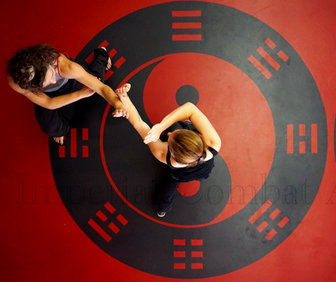
PAKUA & THE 8 ANIMALS
Pakua contains traditional animal imagery associated with the trigrams. These differ from the Imperial Eight Animals system taught separately at Imperial Combat Arts.
The two systems:
Pakua is part of Imperial Wu Tang.
The Eight Animals are a separate integrated combat system.
They are trained in parallel but are not the same art.
The two systems:
- Share philosophical trigram structure
- Differ in technical curriculum
- Remain distinct studies
Pakua is part of Imperial Wu Tang.
The Eight Animals are a separate integrated combat system.
They are trained in parallel but are not the same art.
IMPERIAL WU TANG CH'UAN
Pakua is one of the core pillars of Imperial Wu Tang, alongside:
Within this framework, Pakua provides:
Where Hsing I expresses linear force, Pakua refines circular control.
Together, they create complementary structural strategies rather than competing styles.
- Hsing I Ch’uan
- Tai Chi Ch’uan
- Grey Cloud (advanced synthesis)
Within this framework, Pakua provides:
- Maneuvering capability
- Angular disruption
- Environmental adaptability
- Continuous positional adjustment
Where Hsing I expresses linear force, Pakua refines circular control.
Together, they create complementary structural strategies rather than competing styles.
STRUCTURE & CONDITIONING
All Imperial Combat Arts students train general structural conditioning early.
For Pakua practitioners this includes:
Conditioning is progressive and methodical. Structural adaptation is prioritized over speed.
Pakua power is not spinning for its own sake. It is torque transmitted through grounded stepping and unified rotation.
For Pakua practitioners this includes:
- Leg endurance through circle walking
- Rotational core strength
- Palm conditioning
- Forearm development
- Impact training with alignment emphasis
Conditioning is progressive and methodical. Structural adaptation is prioritized over speed.
Pakua power is not spinning for its own sake. It is torque transmitted through grounded stepping and unified rotation.
PAKUA SETS & APPLICATION
Traditional palm changes are drilled first in isolation, then in flow.
Partner sets train:
Application progresses from cooperative drilling to controlled resistance.
Rather than static technique exchange, Pakua application emphasizes movement while engaging.
Partner sets train:
- Entry against linear force
- Redirection of strikes
- Joint control during movement
- Off-balancing while turning
- Continuous positional dominance
Application progresses from cooperative drilling to controlled resistance.
Rather than static technique exchange, Pakua application emphasizes movement while engaging.
WEAPON RELATIONSHIP
Pakua has a long association with weapons training.
Historically documented weapons in Pakua lineages include:
At Imperial Combat Arts, Pakua mechanics are trained alongside:
Students are taught that footwork principles remain consistent whether armed or unarmed.
Historically documented weapons in Pakua lineages include:
- Saber
- Straight sword
- Spear
- Staff
- Deer Horn Knives
At Imperial Combat Arts, Pakua mechanics are trained alongside:
- Classical weapons
- Blade adaptation
- Short weapon integration
- Modern defensive tools
Students are taught that footwork principles remain consistent whether armed or unarmed.
HISTORICAL CONTEXT
Pakua Chang is widely attributed to Dong Haichuan (1813–1882), who taught in Beijing during the Qing Dynasty.
His prominent students included:
Pakua evolved through these lineages during the late Qing and Republican eras.
While some historical accounts describe palace guard and bodyguard associations, modern scholarship recognizes that Pakua developed through civilian and martial circles rather than a single centralized military system.
Imperial Combat Arts presents Pakua as:
We do not claim exclusive ownership of historical Pakua, but train a preserved branch within the broader tradition.
His prominent students included:
- Yin Fu
- Cheng Tinghua
- Ma Gui
- Others who formed major branches
Pakua evolved through these lineages during the late Qing and Republican eras.
While some historical accounts describe palace guard and bodyguard associations, modern scholarship recognizes that Pakua developed through civilian and martial circles rather than a single centralized military system.
Imperial Combat Arts presents Pakua as:
- Historically rooted
- Taoist-influenced
- Structurally preserved
- Responsibly adapted
We do not claim exclusive ownership of historical Pakua, but train a preserved branch within the broader tradition.
PAKUA & THE 8 ANIMAL STYLE
Pakua contains traditional animal imagery associated with the trigrams. These differ from the Imperial Eight Animals system taught separately at Imperial Combat Arts.
The two systems:
Pakua is part of Imperial Wu Tang.
The Eight Animals are a separate integrated combat system.
They are trained in parallel but are not the same art.
The two systems:
- Share philosophical trigram structure
- Differ in technical curriculum
- Remain distinct studies
Pakua is part of Imperial Wu Tang.
The Eight Animals are a separate integrated combat system.
They are trained in parallel but are not the same art.
IMPERIAL WU TANG CH'UAN
Pakua is one of the core pillars of Imperial Wu Tang, alongside:
Within this framework, Pakua provides:
Where Hsing I expresses linear force, Pakua refines circular control.
Together, they create complementary structural strategies rather than competing styles.
- Hsing I Ch’uan
- Tai Chi Ch’uan
- Grey Cloud (advanced synthesis)
Within this framework, Pakua provides:
- Maneuvering capability
- Angular disruption
- Environmental adaptability
- Continuous positional adjustment
Where Hsing I expresses linear force, Pakua refines circular control.
Together, they create complementary structural strategies rather than competing styles.