One of the most common misunderstandings in martial arts is the idea that a style is primarily designed to fight itself.
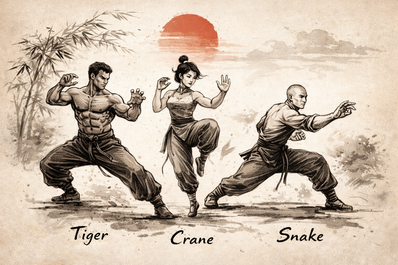
Students often imagine scenarios like Tiger versus Tiger, or Crane versus Crane, as if systems were developed in isolation and tested only against identical methods.
Historically, this was not the case.
Martial arts were developed to deal with whatever opponent stood in front of you, not a mirror image of your own training.
Understanding this changes how you approach training, sparring, and even how you interpret techniques.
Students often imagine scenarios like Tiger versus Tiger, or Crane versus Crane, as if systems were developed in isolation and tested only against identical methods.
Historically, this was not the case.
Martial arts were developed to deal with whatever opponent stood in front of you, not a mirror image of your own training.
Understanding this changes how you approach training, sparring, and even how you interpret techniques.
Martial Arts Did Not Develop in Isolation
Throughout history, martial artists encountered a wide range of opponents.
A practitioner did not have the luxury of preparing only for their own style. They had to be ready for anything.
Because of this, systems evolved to handle differences, not similarities.
A Tiger stylist was not asking:
“How do I fight another Tiger?”
They were asking:
“How do I deal with whatever I encounter?”
- Some were strikers.
- Some were grapplers.
- Some carried weapons.
- Some had entirely different movement systems.
A practitioner did not have the luxury of preparing only for their own style. They had to be ready for anything.
Because of this, systems evolved to handle differences, not similarities.
A Tiger stylist was not asking:
“How do I fight another Tiger?”
They were asking:
“How do I deal with whatever I encounter?”
Styles Are Solutions, Not Identities
Each martial art developed as a solution to specific problems.
These differences are not contradictions. They are responses to different combat challenges.
When you train a style properly, you are not just learning movements.
You are learning a way of solving problems under pressure.
- Some emphasize power and forward pressure
- Some emphasize evasion and timing
- Some emphasize control and redirection
These differences are not contradictions. They are responses to different combat challenges.
When you train a style properly, you are not just learning movements.
You are learning a way of solving problems under pressure.
Why Cross-Style Thinking Matters
If you only train against people who move like you, your understanding becomes limited.
Techniques start to work because your partner is cooperating within the same system, not because they would work against a different approach.
This creates a false sense of effectiveness.
Training must include exposure to different:
Otherwise, the system becomes closed in on itself.
Techniques start to work because your partner is cooperating within the same system, not because they would work against a different approach.
This creates a false sense of effectiveness.
Training must include exposure to different:
- timing
- rhythm
- distance
- intent
Otherwise, the system becomes closed in on itself.
Historical Reality: Adaptation Was Required
In traditional environments, martial artists often encountered:
There was no guarantee of familiarity.
The ability to adapt quickly was not optional. It was essential.
This is one of the reasons martial arts continued to evolve across generations.
They had to remain functional against changing threats.
- traveling fighters from other regions
- military systems with weapons
- rival schools with different training methods
There was no guarantee of familiarity.
The ability to adapt quickly was not optional. It was essential.
This is one of the reasons martial arts continued to evolve across generations.
They had to remain functional against changing threats.
Modern Parallels
Today, the environment has changed, but the principle remains the same.
A student is more likely to encounter:
Training that ignores these realities becomes outdated.
The goal is not to abandon traditional systems.
The goal is to ensure those systems are applied in a way that remains relevant.
A student is more likely to encounter:
- boxing
- Muay Thai
- wrestling
- jiu-jitsu
Training that ignores these realities becomes outdated.
The goal is not to abandon traditional systems.
The goal is to ensure those systems are applied in a way that remains relevant.
Weapons Follow the Same Principle
This idea extends beyond empty-hand training.
A common mistake is thinking:
“staff versus staff”
“sword versus sword”
Historically, this was rarely the case.
Weapons had to function against:
Training a weapon only against itself creates the same limitation as training a style only against itself.
A common mistake is thinking:
“staff versus staff”
“sword versus sword”
Historically, this was rarely the case.
Weapons had to function against:
- different weapons
- unarmed opponents
- multiple opponents
Training a weapon only against itself creates the same limitation as training a style only against itself.
The Principle Remains the Same
Whether empty-hand or weapon-based, the core idea is unchanged:
Your system must function against what is in front of you, not what is familiar to you.
This is what keeps a martial art alive.
Your system must function against what is in front of you, not what is familiar to you.
This is what keeps a martial art alive.
Final Perspective
Martial arts are not closed systems designed to compete within themselves.
They are adaptive systems designed to function in unpredictable situations.
When you understand this, your training shifts:
The question is no longer:
“Does this work against my style?”
The question becomes:
“Does this work against resistance, variation, and reality?”
— Mang Taan
Founder
Imperial Combat Arts
They are adaptive systems designed to function in unpredictable situations.
When you understand this, your training shifts:
- You stop looking for identical movement
- You start recognizing underlying principles
- You begin to see how your system applies across different opponents
The question is no longer:
“Does this work against my style?”
The question becomes:
“Does this work against resistance, variation, and reality?”
— Mang Taan
Founder
Imperial Combat Arts