COMBAT MARTIAL ARTS
实战武艺
Imperial Combat Arts is a comprehensive combat training system taught in Denver, Colorado. The curriculum integrates traditional Chinese martial frameworks with modern conditioning, weapons study, and pressure-tested application.
“Combat” in our school refers to structured, progressive training designed to function under resistance — not performance, sport rules, or theatrical display.
Our system includes:
These elements are developed together rather than as isolated disciplines.
“Combat” in our school refers to structured, progressive training designed to function under resistance — not performance, sport rules, or theatrical display.
Our system includes:
- Striking and structural penetration
- Clinch and grappling integration
- Joint locking (Chin Na)
- Ground fighting
- Melee weapon training
- Tactical movement and environmental awareness
These elements are developed together rather than as isolated disciplines.
IMPERIAL WU TANG CHUAN
武當拳
Imperial Wu Tang Ch’uan is the internal-combative foundation of our training system. It integrates three classical Chinese martial arts into a unified framework:
These arts share Taoist philosophical roots and complementary combat doctrines. When trained together, they produce a balanced system of:
Imperial Wu Tang is not practiced as demonstration art or health exercise alone. It is trained as a functional combat framework emphasizing structure, alignment, and applied mechanics.
→ Enter Page: Imperial Wu Tang Ch’uan
- H’sing I Ch’uan (Xing Yi Quan)
- Pa Kua Chang (Baguazhang)
- Tai Chi Ch’uan (Taijiquan)
These arts share Taoist philosophical roots and complementary combat doctrines. When trained together, they produce a balanced system of:
- Linear force and entry (Hsing I)
- Circular maneuvering and angle control (Pakua)
- Structural refinement and sensitivity (Tai Chi)
Imperial Wu Tang is not practiced as demonstration art or health exercise alone. It is trained as a functional combat framework emphasizing structure, alignment, and applied mechanics.
→ Enter Page: Imperial Wu Tang Ch’uan
IMPERIAL EIGHT ANIMAL SYSTEM
帝國八獸拳
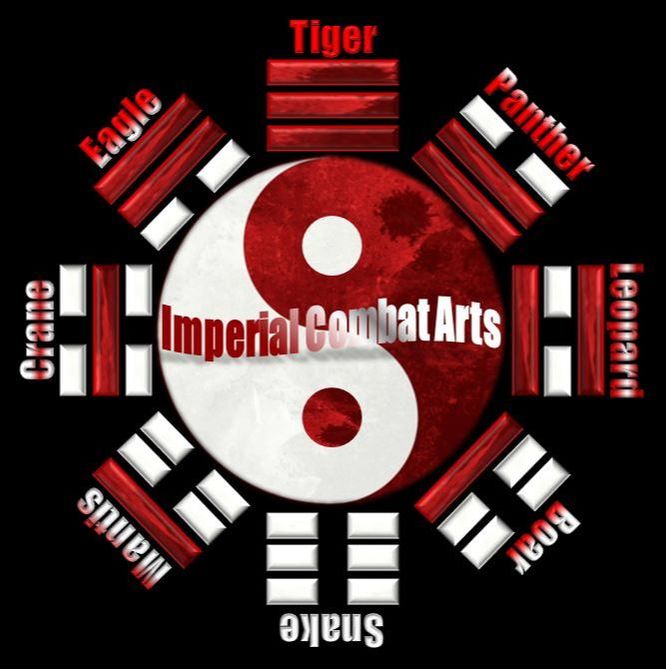
The Imperial Eight Animals form a complete combat system within our school. Each animal represents a fully developed martial framework with its own:
The Eight Animals are trained first as individual systems, then as an integrated strategy for addressing varied opponent types, body structures, and tactical scenarios.
The eight primary animals are:
Together they represent a structured combat matrix rather than symbolic imitation.
→ Enter Page: Imperial Eight Animals
- Conditioning methodology
- Hand weapons
- Forms and sets
- Grappling and Chin Na
- Weapon integration
The Eight Animals are trained first as individual systems, then as an integrated strategy for addressing varied opponent types, body structures, and tactical scenarios.
The eight primary animals are:
- Tiger
- Panther
- Leopard
- Wild Boar
- Eagle
- Crane
- Mantis
- Snake
Together they represent a structured combat matrix rather than symbolic imitation.
→ Enter Page: Imperial Eight Animals
STRUCTURE & CONDITIONING
All combat training at Imperial Combat Arts is supported by progressive conditioning.
Students develop:
Conditioning is introduced gradually and scaled responsibly. Bone, connective tissue, and joint adaptation develop together to ensure durability and longevity.
Impact training and toughening are not performed for spectacle, but to ensure that techniques function under realistic pressure.
Students develop:
- Structural alignment under load
- Progressive impact tolerance
- Grip and forearm strength
- Joint integrity
- Core integration
Conditioning is introduced gradually and scaled responsibly. Bone, connective tissue, and joint adaptation develop together to ensure durability and longevity.
Impact training and toughening are not performed for spectacle, but to ensure that techniques function under realistic pressure.
WEAPON INTEGRATION
Weapon study is foundational within our curriculum.
Training includes:
Empty-hand mechanics and weapon mechanics are taught as structurally related disciplines, not separate studies.
Modern defensive tool awareness is addressed within proper legal and ethical context.
→ Enter Page: Weapon Training
Training includes:
- Traditional Chinese weapons (spear, staff, sword, saber)
- Short blade and impact weapons
- Structural translation from weapon to empty hand
- Tactical application principles
Empty-hand mechanics and weapon mechanics are taught as structurally related disciplines, not separate studies.
Modern defensive tool awareness is addressed within proper legal and ethical context.
→ Enter Page: Weapon Training
SUPPLEMENTAL CROSS-TRAININGI
Imperial Combat Arts also incorporates supplemental training in contemporary combat disciplines to broaden practical context.
These include:
These arts provide:
Supplemental systems are used to strengthen core training, not replace it.
→ Enter Page: Supplemental Cross-Training
These include:
- Brazilian Jiu-Jitsu
- Boxing
- Muay Thai
- Modern grappling formats
These arts provide:
- Live sparring experience
- Timing under resistance
- Clinch and ground sensitivity
- Sport-to-combat contrast understanding
Supplemental systems are used to strengthen core training, not replace it.
→ Enter Page: Supplemental Cross-Training
GROUND FIGHTING & BLACK SCORPION
Our internal ground system, Black Scorpion, integrates:
Ground training is approached as part of an integrated combat system rather than a separate sport discipline.
→ Enter Page: Ground Fighting
- Positional control
- Joint manipulation
- Transition between standing and ground
- Multi-opponent awareness
Ground training is approached as part of an integrated combat system rather than a separate sport discipline.
→ Enter Page: Ground Fighting
COMBAT PHILOSOPHY
Imperial Combat Arts trains for:
We do not train for ring points or performance choreography. At the same time, training is conducted with supervision, progression, and responsible standards appropriate to modern practitioners.
- Structural dominance
- Adaptability across ranges
- Awareness of multiple directions
- Integration of striking, grappling, and maneuvering
We do not train for ring points or performance choreography. At the same time, training is conducted with supervision, progression, and responsible standards appropriate to modern practitioners.
HISTORICAL CONTEXT
Our system draws from classical Chinese martial traditions transmitted to the United States in the mid-20th century. Over decades of teaching and refinement, the curriculum has been organized into a coherent structure under Imperial Combat Arts.
We do not claim unbroken battlefield lineage narratives. Instead, we present a historically rooted martial framework trained today with:
The result is a system that preserves structural principles while remaining grounded in reality.
We do not claim unbroken battlefield lineage narratives. Instead, we present a historically rooted martial framework trained today with:
- Modern safety standards
- Progressive resistance
- Conditioning science awareness
- Ethical responsibility
The result is a system that preserves structural principles while remaining grounded in reality.
WHO IS THIS TRAINING FOR
This program is designed for individuals seeking serious martial development rather than casual recreation.
Students who thrive here are:
Whether beginner or experienced martial artist, advancement is based on demonstrated skill — not time served.
Students who thrive here are:
- Consistent
- Disciplined
- Willing to train progressively
- Interested in both tradition and application
Whether beginner or experienced martial artist, advancement is based on demonstrated skill — not time served.